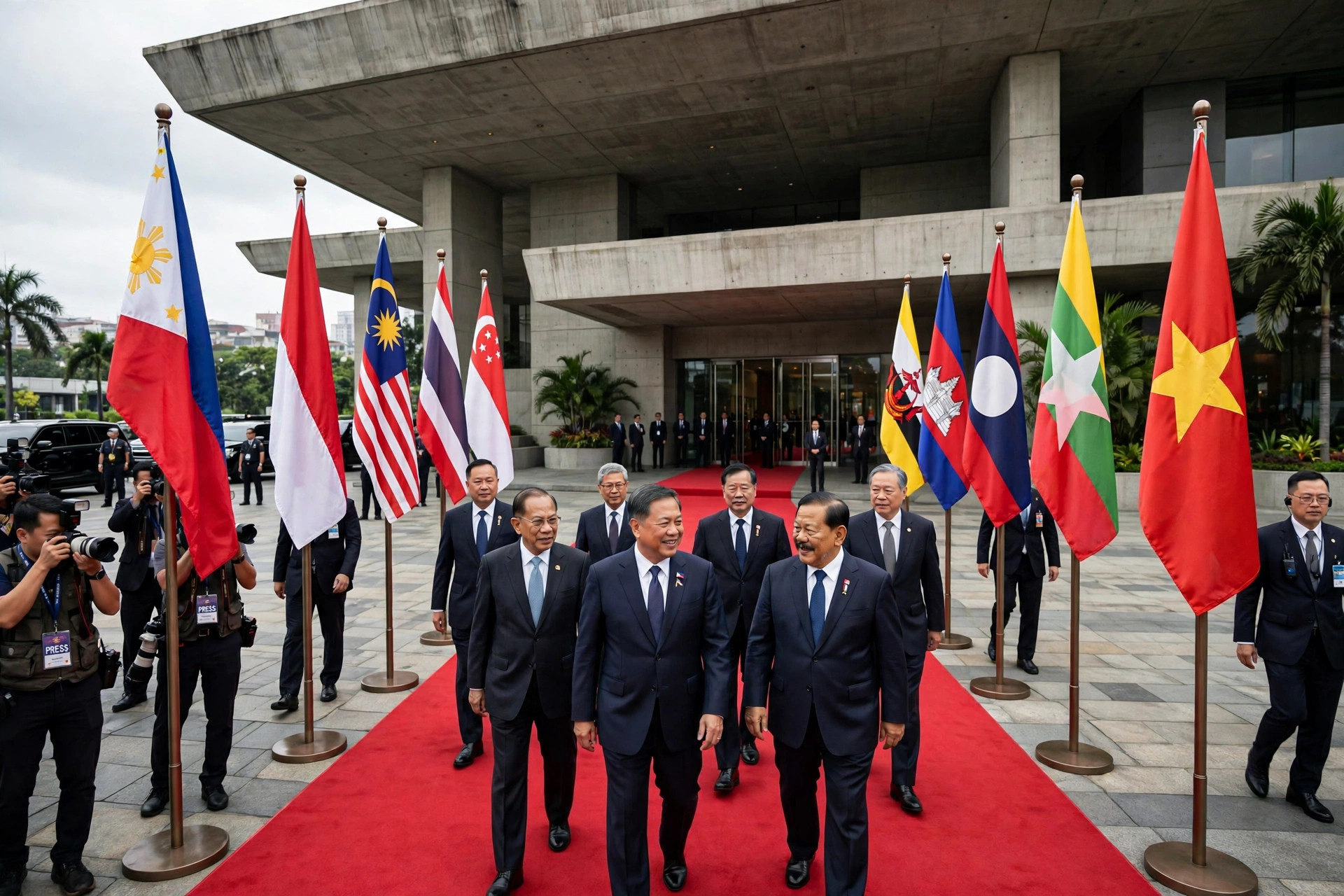
World leaders have begun arriving in Manila for the 49th ASEAN Summit, the biggest diplomatic gathering of the Philippines' year as chair of the Southeast Asian bloc, with the South China Sea, Myanmar and trade high on the agenda.
The summit opens on Sunday, 15 November, at the Philippine International Convention Center in Pasay City, where President Ferdinand Marcos Jr. will chair the opening ceremony, plenary and retreat sessions with the leaders of the bloc's member states.
Who is attending the Manila summit
Nine Southeast Asian leaders are joining Mr Marcos for the opening sessions, according to the Philippines' Department of Foreign Affairs. Timor-Leste, admitted as the bloc's 11th member last year, is also represented, while Myanmar — whose leaders have been sidelined from ASEAN summits since the 2021 military takeover — will be represented by a director-general from its foreign ministry.
Canadian Prime Minister Mark Carney and Brazilian President Luiz Inácio Lula da Silva will attend the plenary as guests of the chair, alongside a representative of the International Monetary Fund.
Dialogue partners arrive on Monday
The related summits with ASEAN's dialogue partners run from 16 to 17 November. Australian Prime Minister Anthony Albanese, Chinese Premier Li Qiang, Indian Prime Minister Narendra Modi, Japanese Prime Minister Sanae Takaichi, South Korean President Lee Jae-myung and United Nations Secretary-General António Guterres are all expected in Manila, while Russia will be represented by Foreign Minister Sergey Lavrov.
US President Donald Trump is expected to arrive on the final day, 17 November, for a Special ASEAN-US Summit. Chinese President Xi Jinping is not expected to attend, according to Philippine media reports.
South China Sea code tops the agenda
The headline deliverable of the Philippines' chairmanship is a code of conduct with China in the South China Sea, a set of rules intended to manage competing territorial claims in the disputed waterway. Philippine officials have said, however, that no final agreement is expected to be concluded at the Manila meeting, with negotiations still under way.
The Philippines set four deliverables for its year as chair: the code of conduct, an ASEAN Centre on Maritime Studies in Manila, a Digital Economy Framework Agreement and promotion of the so-called silver economy, which supports older populations across the region.
Myanmar and regional challenges in focus
Leaders will also review Myanmar's adherence to ASEAN's Five-Point Consensus, the bloc's plan for ending the violence and restoring dialogue in the country, which has been in civil war since the military seized power. The situation in Myanmar has been a recurring test of the bloc's unity, and diplomats say it will feature prominently in the retreat session.
The summit comes at a crowded moment for Asian diplomacy. It sits between a US-China trade truce due to run until 10 January 2027 and the APEC leaders' meeting in Shenzhen, which Mr Trump is due to attend immediately afterwards.
What happens next
On 17 November, Mr Marcos will chair the 29th ASEAN Plus Three Summit with China, Japan and South Korea, as well as the 21st East Asia Summit, which covers regional strategic, political and economic issues. He will then lead the closing ceremony and hand the rotating ASEAN chairmanship to Singapore, which takes over after the Manila meetings.
The previous ASEAN leaders' summit was held in Cebu last May. With leaders from 11 member states and 12 dialogue partners in the room, Manila is set for three days of diplomacy that will shape the bloc's direction into 2027.
Related coverage on TrendWire
- Trump, Xi and Putin to Hold Historic Three-Way Talks in Shenzhen
- Xi-Trump-Putin Summit: Beijing Confirms Historic Three-Way Talks
- COP31 Climate Summit Opens in Turkey Amid UN Extremes Warning
Tags: #ASEANSummit #Manila #SouthChinaSea #DonaldTrump #Philippines #ASEAN #WorldNews #Diplomacy
Comments (0)