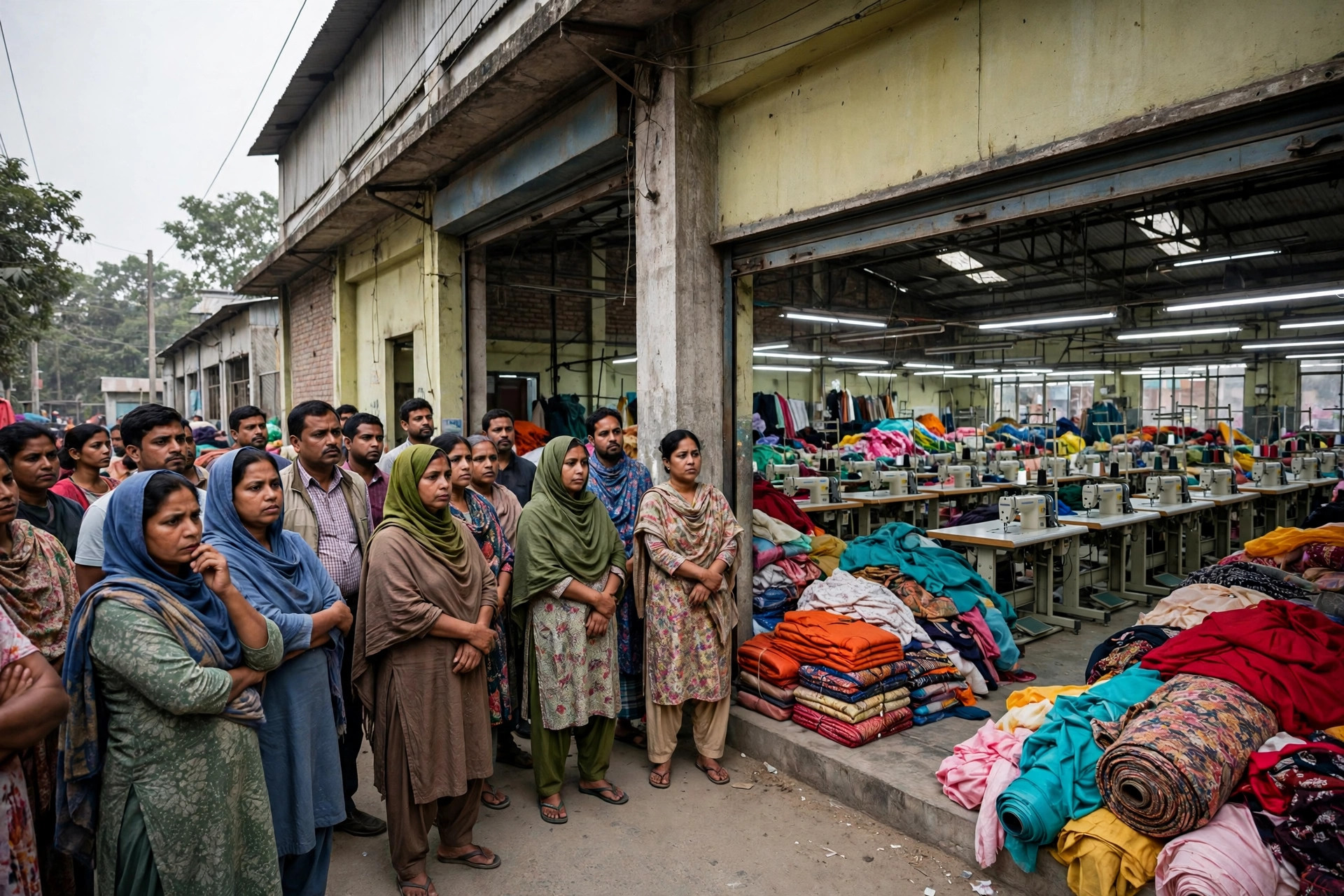
Bangladesh's garment industry, the country's biggest export earner, is sliding towards a shutdown crisis after factory owners shut dozens of plants indefinitely and warned that many more could follow if workers do not return to their jobs. The standoff, centred on a demand for a much higher minimum wage, has already halted production at nearly 150 factories in the industrial belts around Dhaka.
Fifty-Five Bangladesh Garment Factories Closed Under 'No Work, No Pay'
The Bangladesh Garment Manufacturers and Exporters Association (BGMEA) said on Saturday that 55 factories have been closed indefinitely under Section 13(1) of the Bangladesh Labour Act, 2006, the provision commonly described as "no work, no pay". Under the rule, workers receive no wages or allowances for the period a factory remains shut because of illegal strikes or unrest.
BGMEA President Mahmud Hasan Khan announced the move at a press conference at the association's building in Uttara, Dhaka, warning that factories unable to resume production because of the unrest would be forced to close indefinitely from Sunday, 15 November, under the same provision.
Production was suspended on Saturday at 147 factories in Savar, Ashulia and Gazipur, the country's main garment manufacturing hubs, as workers did not report for duty or owners feared vandalism, according to the BGMEA. Industrial police said around 40 factories in the Savar-Ashulia belt alone had been closed indefinitely, with closure notices posted at factory gates citing protests, unauthorised work stoppages and deteriorating law and order.
Workers Demand Tk30,000 Minimum Wage
Garment workers have been protesting since mid-October, demanding a minimum monthly wage of Tk30,000 (about US$240) — a rise of roughly 140% on the current Tk12,500, which was set in 2023. Workers are also seeking payment of outstanding wages and benefits, an end to blacklisting and the reinstatement of dismissed workers.
The protests have at times turned violent, with demonstrators torching police vehicles and damaging property during clashes this month, according to reports. Police have arrested 132 people in connection with cases filed over the incidents.
On Saturday, protests were concentrated around Chandra and Palli Bidyut in Kaliakair, Gazipur, where workers from several factories stopped work and blocked the Dhaka-Tangail Highway, bringing traffic in both directions to a halt.
Owners threaten to quit wage talks
The BGMEA and the Bangladesh Knitwear Manufacturers and Exporters Association (BKMEA) sharpened their rhetoric on Saturday, threatening to walk away from wage negotiations and shut factories indefinitely if protesters kept vandalising them. The BGMEA president could not say how many factories might eventually be shut, saying the affected units vary from day to day.
Wage Board Meeting Set for Monday
The government formed a six-member minimum wage board on 1 November and said a revised wage structure would apply from December, with the first higher pay expected in January. At the board's meeting on 9 November, the workers' representative Babul Akter proposed a minimum monthly wage of Tk32,000, and Tk30,000 for trainees.
The BGMEA confirmed it will attend the next wage board meeting on Monday, 16 November, and submit the owners' proposal on the day. Worker leaders said the board's process to determine fair wages is under way, but the board has not yet produced an employer offer or a final wage figure.
What Happens Next
All eyes are now on Monday's meeting. If the owners table a proposal close to the workers' demand, production could restart quickly. But if talks stall, the closures could spread well beyond the 55 factories already shut — hitting workers' incomes and disrupting orders for global clothing brands.
Tags: #Bangladesh #GarmentWorkers #MinimumWage #BGMEA #Dhaka #LabourRights #WageProtest #BangladeshEconomy
Comments (0)