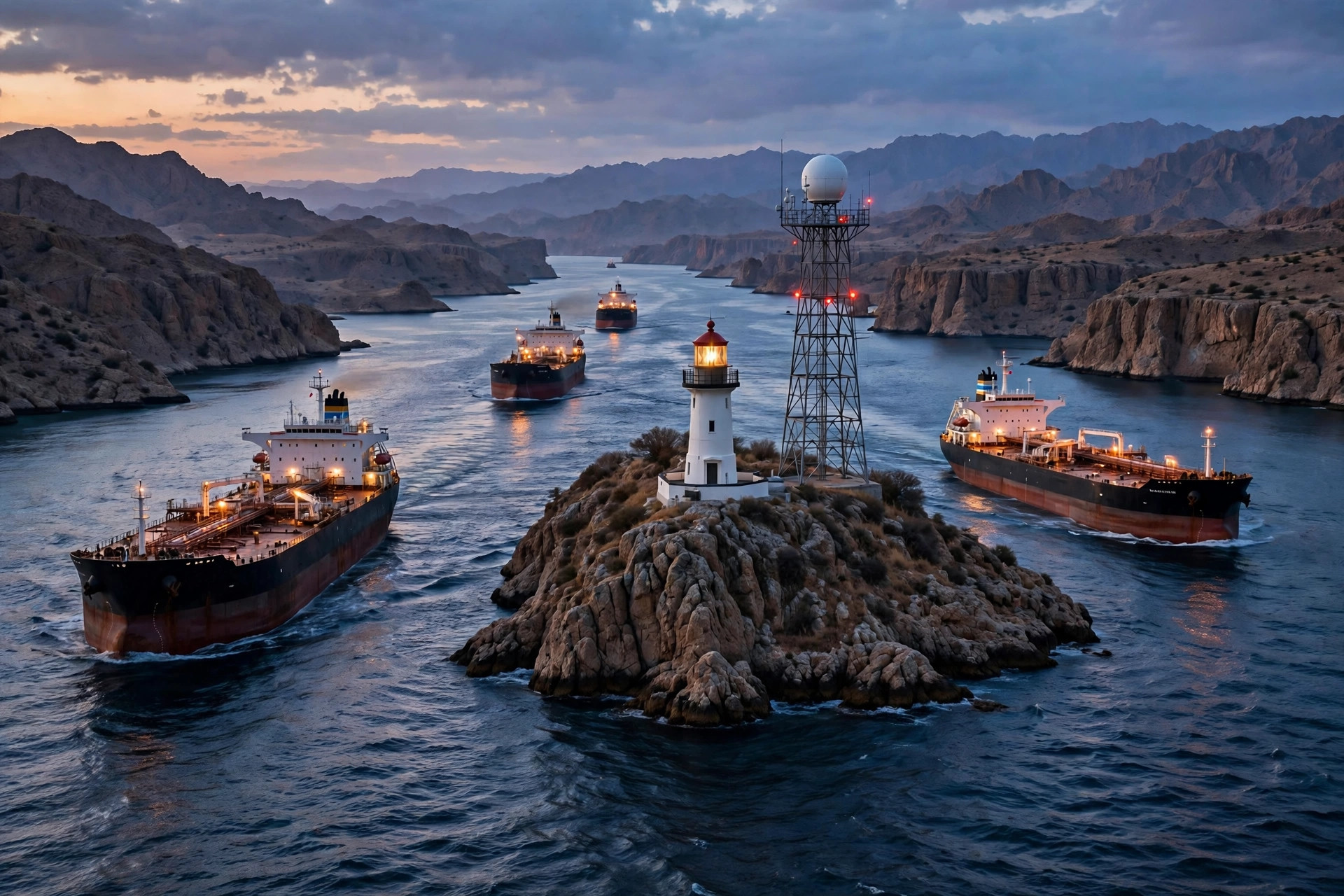
Iran has claimed responsibility for an attack on navigation systems on a small Omani island in the Strait of Hormuz, raising fresh questions about the safety of one of the world's most important oil shipping routes. Iranian state media said on Tuesday that the Islamic Revolutionary Guard Corps (IRGC) navy had destroyed "enemy navigation systems" on Didamar Island. Three sources confirmed to Reuters on Wednesday that the island's navigation systems had been attacked, although the extent of the damage remains unclear.
What happened on Didamar Island
Didamar Island, also known to mariners as Little Quoin Island, sits roughly 10 nautical miles north of the tip of Oman's Musandam Peninsula. It hosts a 25-metre radar tower, a radio relay carrying Channel 16 — the international maritime distress and calling frequency — and a lighthouse dating to 1914 with a nominal range of 23 nautical miles.
Iran's Fars News Agency described the strike as targeting systems it said were supporting "unauthorised" ship transits through the strait. An unnamed IRGC official told Business Upturn the systems had been destroyed and that no vessel had crossed the southern route overnight. Reuters said it had confirmed video showing smoke rising from the island, although it could not independently verify what had been destroyed. An Omani Coast Guard official confirmed an explosion on the island but gave no further details.
Oman disputes the damage
A senior Omani official told The Maritime Executive that the navigation aids on Didamar had not been struck. Satellite imagery from the European Union's Copernicus Sentinel-2 programme, dated 10 November, appears to support that assessment, showing no obvious damage to the lighthouse or the radar and radio masts.
The Institute for the Study of War (ISW) put the attack on 8 November — two days before Iranian state media claimed responsibility — and questioned the extent of the damage, noting that commercial vessels continued to use the southern route afterwards. Scorch marks near the radar and radio equipment were visible in satellite imagery from 8 November, although what caused them has not been established.
Why the Strait of Hormuz matters
The Strait of Hormuz connects the Persian Gulf to the Gulf of Oman and the Arabian Sea, and it is the corridor through which a large share of the world's seaborne oil travels. Iran closed the strait in February, and the US Navy has imposed a blockade of Iranian ports since April, with American forces escorting commercial vessels through the waterway. Gulf oil exporters have been working to restore shipments disrupted by the conflict.
Shipping sources told Reuters the Didamar attack would probably have limited impact on commercial traffic, because other navigation systems are in place elsewhere in the strait. Even so, the strike is significant because it targeted the sovereign infrastructure of Oman — a long-time mediator between Tehran and Washington — rather than a vessel at sea.
What happens next
The incident comes at a sensitive moment. Iran had for months described its deal with Oman to reopen the strait as being "in its final stages", and the diplomatic track between Tehran and Muscat now appears close to collapse. Iran's foreign minister has described military strikes on Oman as "not our choice", but the IRGC had already targeted Omani radar systems in July.
Meanwhile, the Wall Street Journal has reported that US Vice President JD Vance is considering face-to-face talks with Iranian Security Chief Mohsen Rezaei, and Iran has threatened to strike any base from which American aircraft seeking to bomb Iran would take off. For now, the key questions are whether the damage to Didamar can be verified independently and whether the diplomatic channel between Tehran and Muscat survives the incident.
Related coverage on TrendWire
- US Strikes Iran's Qeshm Island in Strait of Hormuz
- US Disables Cargo Ship Huda as Iran Claims Tankers Hit Mines
- Vance Leads Secret US-Iran Talks to Revive Ceasefire and Nuclear Deal
Tags: #Iran #StraitOfHormuz #Oman #DidamarIsland #MiddleEast #OilShipping #Reuters
Comments (0)