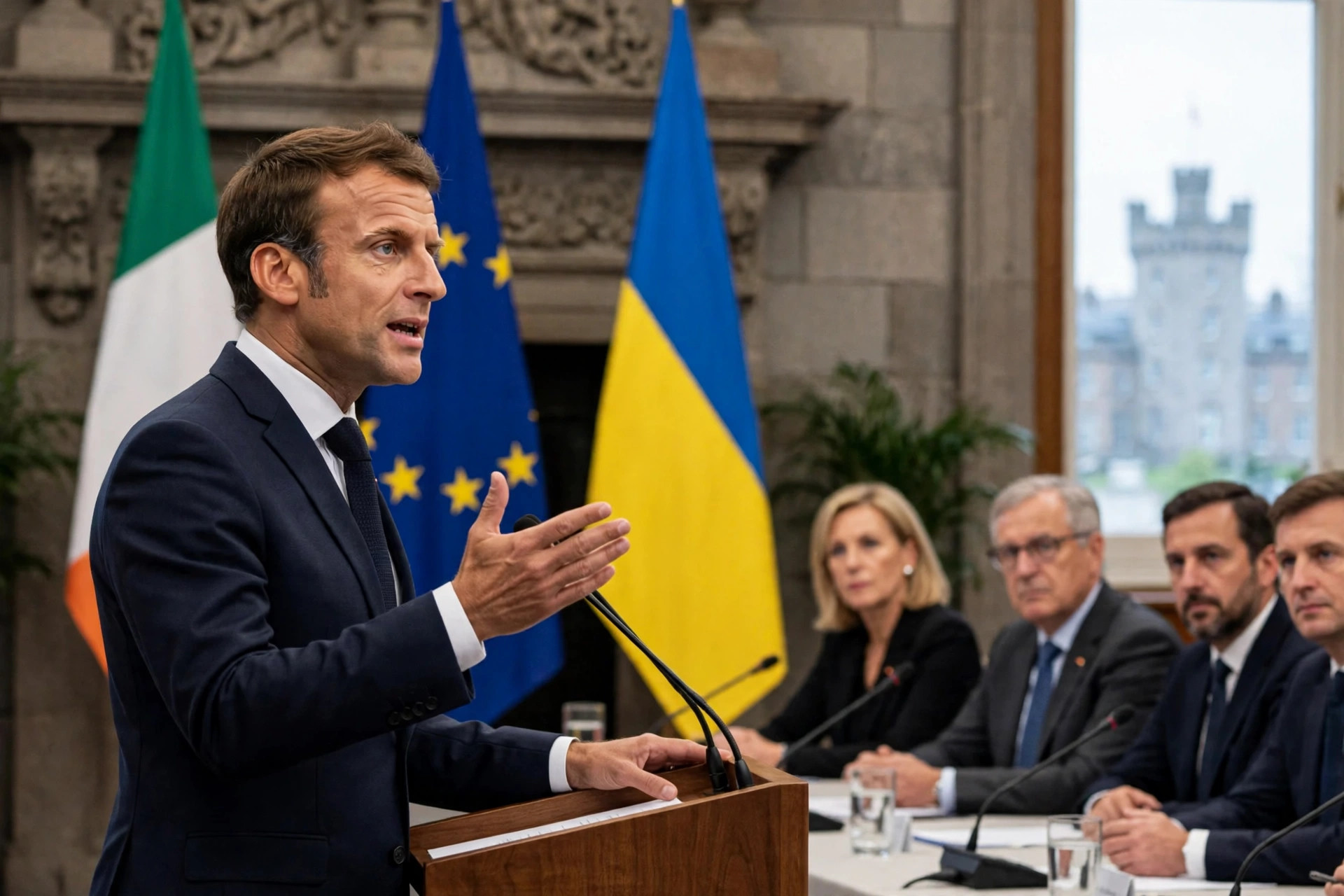
French President Emmanuel Macron has warned that countries seeking to cut back aid to Ukraine risk forcing Kyiv into an “unjust peace” — and paving the way for another war in Europe. In a statement posted on social media on Saturday, 14 November, Mr Macron said those who want to ration support for Ukraine are, in effect, choosing defeat for the whole continent.
“Those who want to ration aid to Ukraine wish underneath it all to force an unjust peace on it,” Mr Macron wrote, adding that such a peace would leave Ukraine permanently vulnerable and, by extension, make Europe vulnerable too. “That is the spirit of defeat. That is a recipe for another war. That cannot be France’s position.”
Macron’s warning over Ukraine aid cuts
The French leader’s intervention came after a week of intense diplomacy in Dublin, where European leaders gathered for the ninth summit of the European Political Community and an informal meeting of the European Council on 12–13 November. According to Mr Macron, the talks produced unity around two priorities: helping Ukraine survive the winter, and working towards a just and lasting peace.
On the first priority, he said Europe must maintain its financial backing and help Ukraine protect its people, its power plants and its electricity grids. The warning carries particular weight as Russia continues to target Ukrainian energy infrastructure, with reports this week describing widespread power outages in the Dnipropetrovsk and Kharkiv regions after overnight strikes.
Mr Macron also argued that Ukraine, which he described as having Europe’s leading conventional army, has a key role to play in NATO, “where it rightfully belongs”. A French-proposed declaration setting out European security principles was backed by 42 countries at the Dublin gathering, according to reports from the summit.
A warning aimed at Washington’s peace push
The remarks are widely seen as a response to the peace proposals circulating in Washington. Ukrainian President Volodymyr Zelenskyy said in comments released on 14 November that the United States had suggested Kyiv cede territory in the Donbas region to Moscow in exchange for Ukraine joining NATO — an idea Mr Zelenskyy has previously rejected.
US envoys Steve Witkoff and Jared Kushner have spent the week mediating between the two sides. They held two days of talks between Russian and Ukrainian delegations in Abu Dhabi, which ended without agreement on territorial issues, before meeting President Vladimir Putin in Moscow and then flying to Dublin, where they briefed Mr Zelenskyy.
Europe wins a seat at the table
On Friday, 13 November, European leaders in Dublin chose five countries — France, Germany, Italy, the United Kingdom and Poland — to send representatives to the talks. The move followed a draft Dublin Declaration, initiated by France’s foreign minister, setting out that peace in Ukraine cannot be settled without Ukraine and that matters affecting Europe’s security cannot be decided without Europeans.
The European Union has already agreed a €90 billion loan to Ukraine for 2026 and 2027.
What happens next for Ukraine peace talks
The immediate question is whether the newly agreed European presence at the negotiating table changes the shape of any deal. Mr Macron has made clear that France will not accept a settlement imposed on Kyiv, and European leaders say their two priorities — winter support and a just peace — must move together.
For now, the diplomacy continues against a difficult backdrop: the Abu Dhabi talks produced no compromise on territory, Russian strikes on energy infrastructure are intensifying as winter approaches, and the gap between Washington’s proposals and Kyiv’s red lines remains wide.
Related coverage on TrendWire
- Ukraine Peace Talks: Europe to Join Next Round
- US Floats Donbas-for-NATO Deal to Ukraine, Zelensky Reveals
- Russia Demands Finland Leave NATO in Abu Dhabi Peace Talks
Tags: #Macron #Ukraine #EuropeanUnion #NATO #RussiaUkraineWar #PeaceTalks #Europe #DublinSummit
Comments (0)