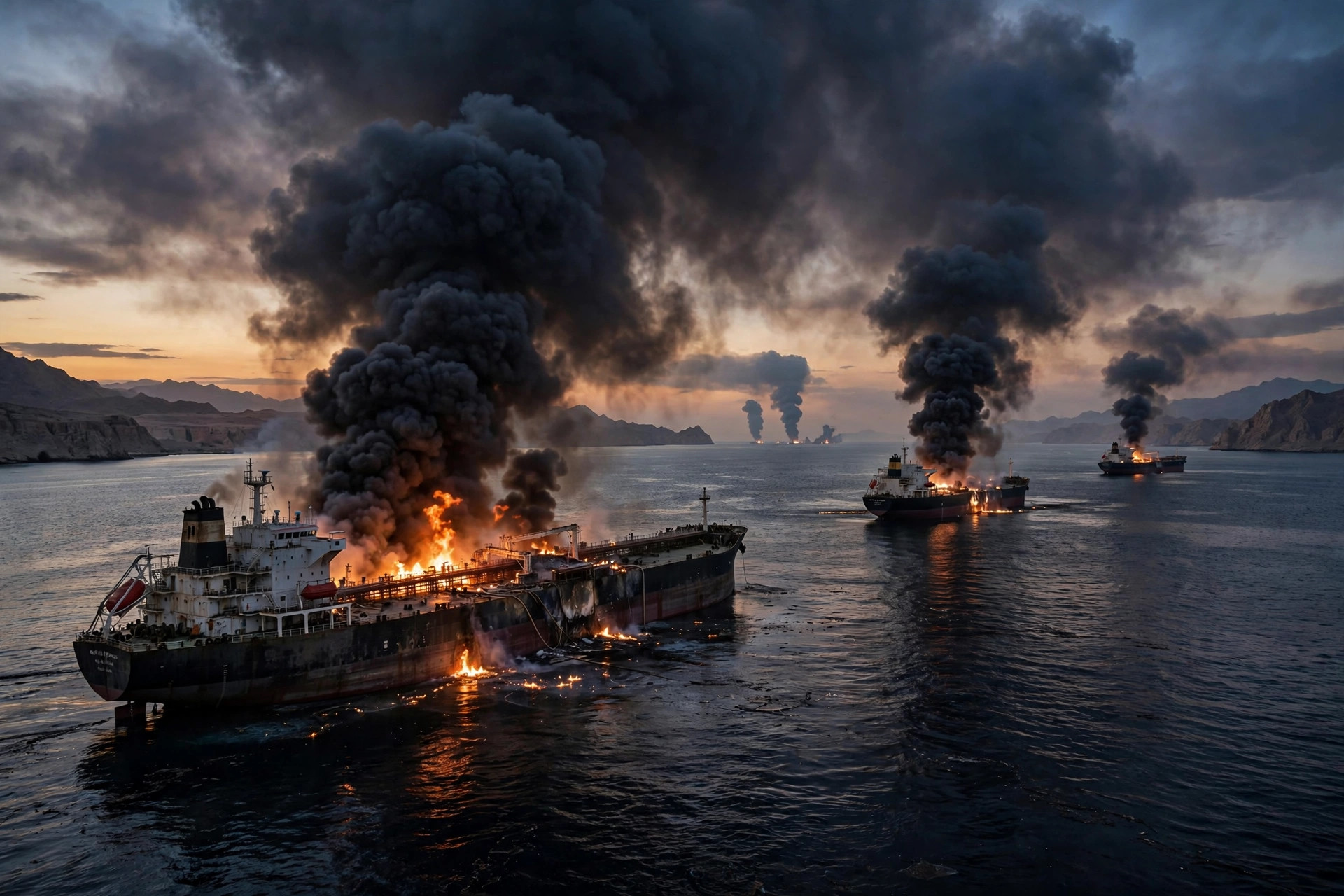
Iran said on Wednesday evening that three oil tankers caught fire after striking naval mines east of the Strait of Hormuz, in the latest incident in the strategic waterway through which a large share of the world's seaborne oil passes.
According to Iran's Islamic Revolutionary Guard Corps (IRGC), the tankers were sailing through restricted areas with their navigation systems switched off and had ignored warnings from Iranian naval forces. The claim was carried by Iran's state-run IRIB news agency, and reported by Al Jazeera and NDTV.
What Iran says happened in the Strait of Hormuz
In statements carried by IRIB, the IRGC said the three vessels had entered areas it described as off-limits to shipping and were attempting to transit an unauthorised route. The resulting fires disabled all three tankers, according to the Iranian army's public relations office, which also said the vessels had switched off their radar and positioning systems.
The IRGC said passage through the waterway must be coordinated with Iranian authorities, and warned shipping companies against using what it called unauthorised routes. Iran did not name the vessels involved, give their flags or owners, or report any casualty figures.
Why the claim cannot be independently verified
The Iranian account could not be independently verified. Reuters reported that it could not confirm the incident, and neither the United Kingdom Maritime Trade Operations (UKMTO) centre nor US Central Command had commented on the announcement at the time of reporting.
The lack of detail matters: for a claim involving three burning tankers in one evening, no shipowner, flag state or insurer had stepped forward to say one of its hulls was hit.
A pattern of disputed claims
The announcement follows a series of similar Iranian statements in recent days. On Monday, the IRGC said mines had damaged six oil tankers since Sunday, a claim US Central Command has previously disputed. Earlier in November, Iran claimed four oil tankers had been destroyed by mines, again without naming vessels or providing independent confirmation.
Same day as the ADNOC tanker attack
The mine claim came on the same day an ADNOC vessel was struck in the same waters. UKMTO confirmed that incident, in which one crew member was reported missing and 11 injured, after the tanker was hit by a projectile of unknown origin north of Khasab in Oman. The morning attack is on the record; the evening claim about the three tankers is not.
The incidents come as the war between the United States, Israel and Iran, which began on 28 February, continues to spread across the region, a day after talks in Muscat failed.
What happens next for shipping through Hormuz
The Strait of Hormuz narrows to 21 miles at its tightest point, with two marked shipping lanes, inbound and outbound, carrying oil from Gulf producers to world markets. Tankers have continued to transport oil through the strait under US military protection despite the recent upsurge in attacks, according to maritime data company Lloyd's List Intelligence.
What shipping companies, insurers and oil markets will watch next is whether independent confirmation emerges, whether UKMTO or US Central Command issues an advisory, and whether Iran enforces its demand that passage be coordinated with its authorities. Any sustained disruption would put immediate pressure on global oil prices.
Related coverage on TrendWire
- Iran Attacks Sink Two Ships in Strait of Hormuz as Oil Flows Collapse
- US Strikes Iran's Qeshm Island in Strait of Hormuz
- US Disables Cargo Ship Huda as Iran Claims Tankers Hit Mines
Tags: #StraitOfHormuz #Iran #OilTankers #MiddleEast #Shipping #OilPrices #BreakingNews #TrendWire
Comments (0)