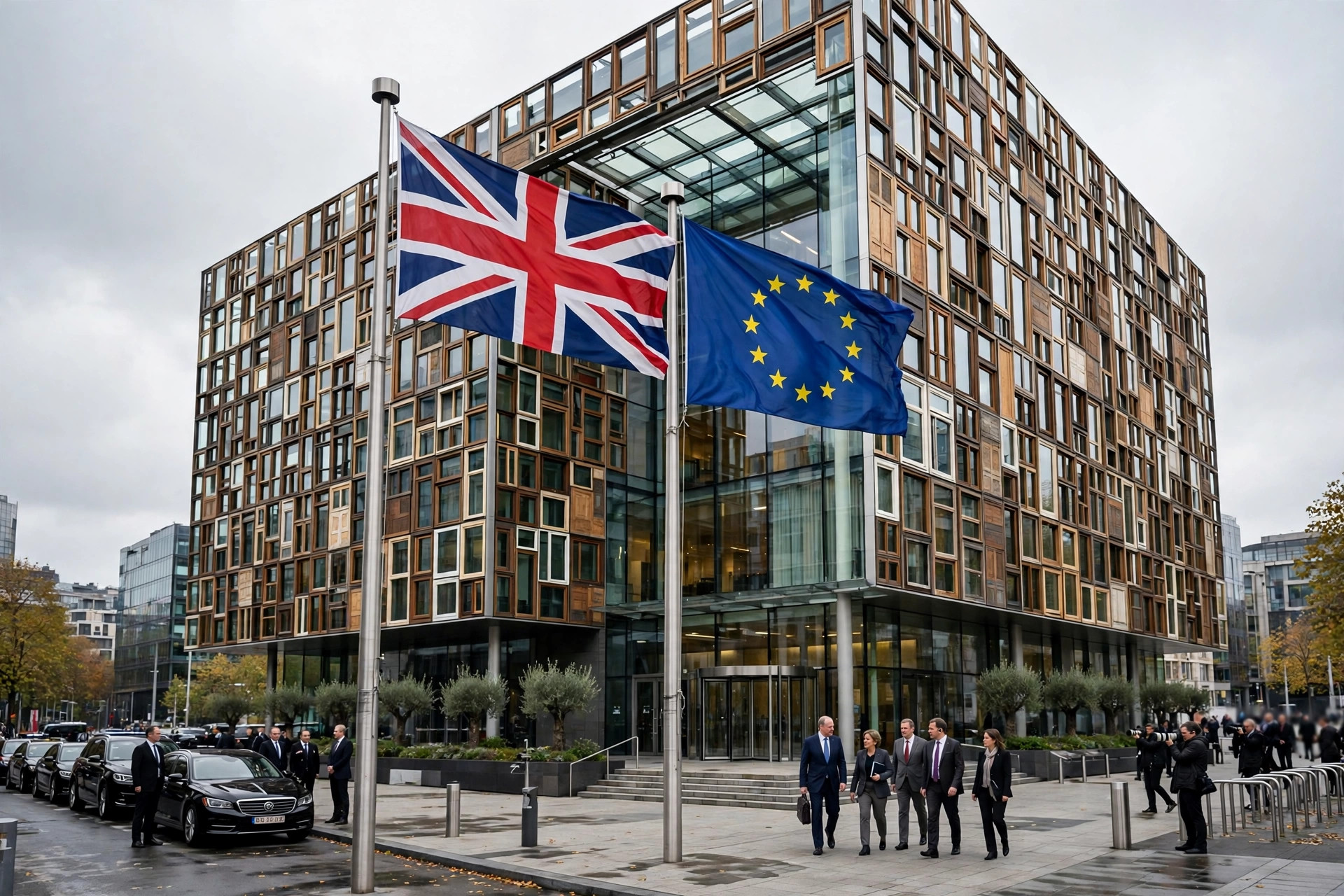
The United Kingdom and the European Union have sealed a landmark post-Brexit reset deal, agreeing measures on food trade, carbon markets and youth mobility a decade after British voters chose to leave the bloc.
After a summit in Brussels on Friday, Downing Street confirmed that negotiations had concluded. "The deal is done," a UK government spokesperson said, adding that both sides would now work towards implementation.
Prime Minister Andy Burnham, meeting European Commission President Ursula von der Leyen and European Council President António Costa, hailed the outcome. "This is a good day for Britain. This is a good day for Europe," he said, calling the agreement a "win-win" that draws a line "on a decade of drift and division".
What the UK-EU reset deal covers
First, a sanitary and phytosanitary agreement will cut checks and paperwork on food, animals and plants traded between Britain and the EU, with Britain aligning with EU agrifood standards. It is estimated to be worth £5.1 billion ($6.7 billion) to Britain, and is expected to take effect in 2028.
The second links the two sides' emissions trading systems, exempting goods such as steel from each other's border carbon levies.
The third is a youth mobility scheme allowing up to 100,000 people under 30 from each side to live and work in the other's territory for up to three years. Burnham said the deal was done to give young people the opportunities Brexit took away.
A turning point — but tuition fees unresolved
Von der Leyen called the deal a "turning point" and set out further collaboration on economic security, defence, AI and illegal immigration.
But one major issue remains unresolved: university tuition fees for European students. Brussels wants EU students to pay domestic rates, not the higher international fees. The two sides have given themselves six months to reach an agreement, and the EU has indicated that a fee cut is a prerequisite for ratifying the package.
"We have not yet reached an agreement on tuition fees, and we have given ourselves six months to reach that agreement," an EU official told reporters.
There was no formal signing on Friday, and no document was inked. Details are due in a joint statement.
Political rows at home — and the longer-term question
Reform UK leader Nigel Farage said the deal breached Labour's manifesto commitments, while Costa said the EU's red lines were unchanged: Britain would have to accept freedom of movement, payments to EU budgets and Brussels' control over UK laws as the price of anything more than "incremental" improvements.
Burnham said the three agreements were "the limit" of what could be achieved in the current parliament, but said talks on the long-term relationship — from joining the EU customs union to eventually rejoining the bloc — would wait until the next EU summit, in about a year's time.
The summit grew out of his predecessor Sir Keir Starmer's approach, delayed when his premiership imploded. Former Europe minister Nick Thomas-Symonds said the deal was "90% there" when Burnham's team took over. Burnham has been prime minister for four months.
At the closing press conference, Burnham and the two European leaders also condemned Russia's recent violation of Polish airspace.
What happens next
The joint statement is expected shortly, legislation will go before Parliament next week, and negotiators have six months to settle the tuition-fees row. Burnham said the package could add 0.5% to Britain's economy — up from his earlier estimate of 0.4%.
For now, both sides present the deal as the start of a reset, not its conclusion — but months of negotiations lie ahead before a deeper reset takes full effect.
Related coverage on TrendWire
- UK Gives Ukraine 1,000 Long-Range Drones in £260m Package
- EU Proposes €45 Billion Ukraine Loan Repaid by Russian Reparations
- Russia Launches Massive Missile Attack on Kyiv After Putin Summit
Tags: #UKEU #BrexitReset #AndyBurnham #EuropeanUnion #UKPolitics #Brussels #YouthMobility #TradeDeal
Comments (0)