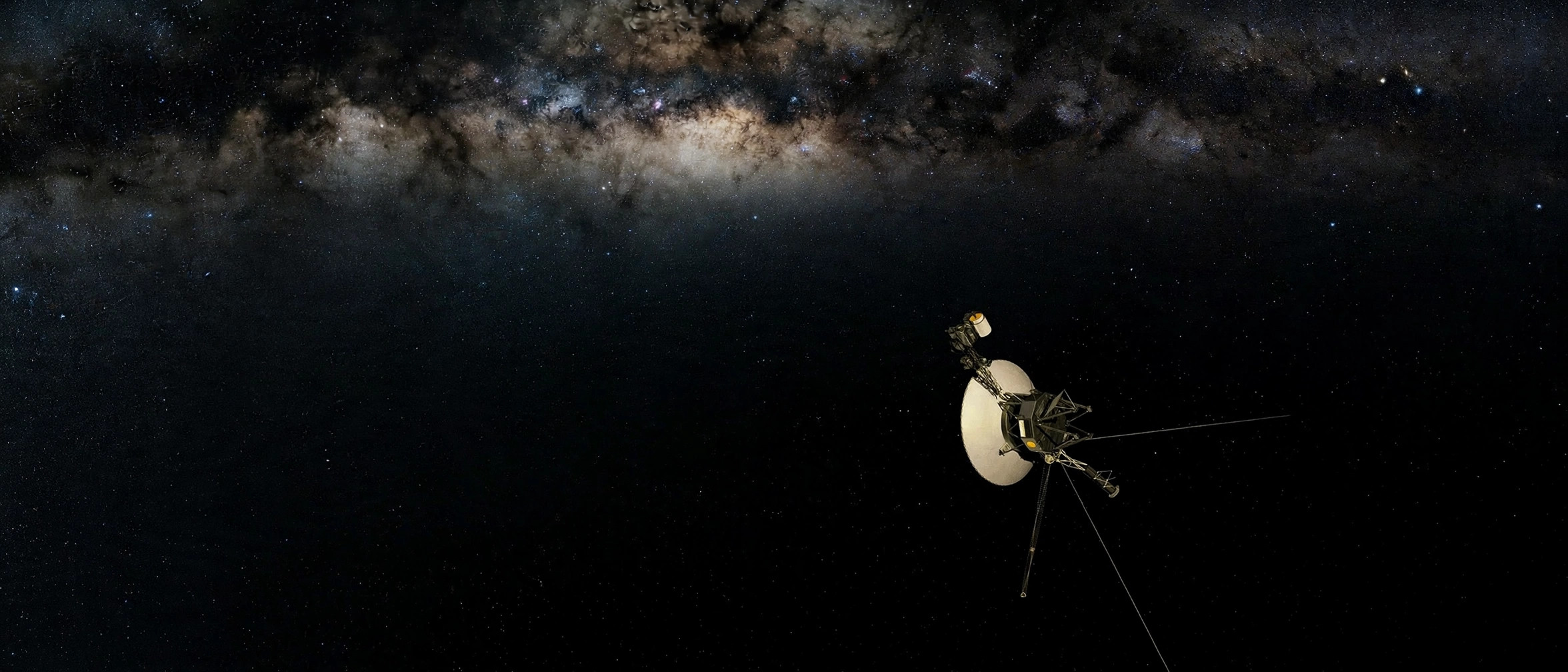
NASA's Voyager 1 has become the first human-made object in history to reach a distance of one light-day from Earth, crossing the milestone on Wednesday, 18 November 2026, nearly 50 years after it left Cape Canaveral. At the moment of crossing, the spacecraft stood about 16 billion miles (26 billion kilometres) from our planet — more than four times the distance from the Sun to Pluto.
Voyager 1 crosses one light-day from Earth
According to NASA's Jet Propulsion Laboratory, Voyager 1 crossed the one-light-day mark at 5:16 a.m. EST on 18 November 2026. A light-day is the distance light travels in 24 hours, so radio signals from Earth now take a full day to reach the spacecraft — and a full day to come back. Any command sent from mission control now faces a 48-hour round trip before engineers can confirm it worked.
"Reaching one light-day is an astounding feat, one that I never expected to see," Voyager project manager Suzanne Dodd said, according to reports of NASA's announcement. Officials at the Jet Propulsion Laboratory in California scheduled an event for Thursday, 19 November, to discuss the milestone, after waiting about a day for the probe's faint signal to confirm the crossing.
A 49-year journey into interstellar space
Voyager 1 launched on 5 September 1977, 16 days after its identical twin Voyager 2, from Cape Canaveral in Florida. The two spacecraft transformed scientists' understanding of the outer solar system, flying past Jupiter and Saturn before heading for the edge of the Sun's influence.
In August 2012, Voyager 1 crossed the heliopause and became the first human-made object to enter interstellar space. It has held the record as the farthest human-made object from Earth since 1998, when it passed NASA's Pioneer 10 probe. Today it is travelling at almost 38,000 miles per hour (61,000 km/h) through the near-emptiness between the stars.
Still flying on 1977 hardware
Remarkably, NASA engineers are still operating hardware launched in 1977. Eight of the spacecraft's original ten instruments are no longer operating, and the output from its plutonium-238 power source degrades a little each year. Engineers have repeatedly found ways to keep it going, using backup thrusters and rerouting power to stretch the mission. NASA expects the remaining power to sustain science operations into the late 2020s or early 2030s.
What happens next for Voyager 1
The probe carries the famous Golden Record, a trove of sounds and images from Earth intended as a message for any curious civilisation that might one day find it. It is headed in the direction of the star Gliese 445, more than 17 light-years away, and could pass within 1.7 light-years of it in about 40,000 years, according to NASA.
For scale, reaching one light-year would take roughly 18,000 years at Voyager 1's current speed. But the next milestone is closer: in the summer of 2027, Voyager 1 and Voyager 2 will each mark 50 years in space — Voyager 2 on 20 August and Voyager 1 on 5 September. Until then, every signal from the most distant traveller humanity has ever launched takes a full day to arrive, a quiet reminder of just how far from home it has gone.
Related coverage on TrendWire
- CERN Finds Evidence of One-in-Ten-Billion Particle Decay
- SpaceX Unveils $74bn AI Supercomputing Campuses in Texas and Arizona
- SpaceX-Tesla Merger Talks Advance Towards Record December Deal
Tags: #Voyager1 #NASA #InterstellarSpace #SpaceExploration #SpaceNews #ScienceNews #DeepSpace
Comments (0)