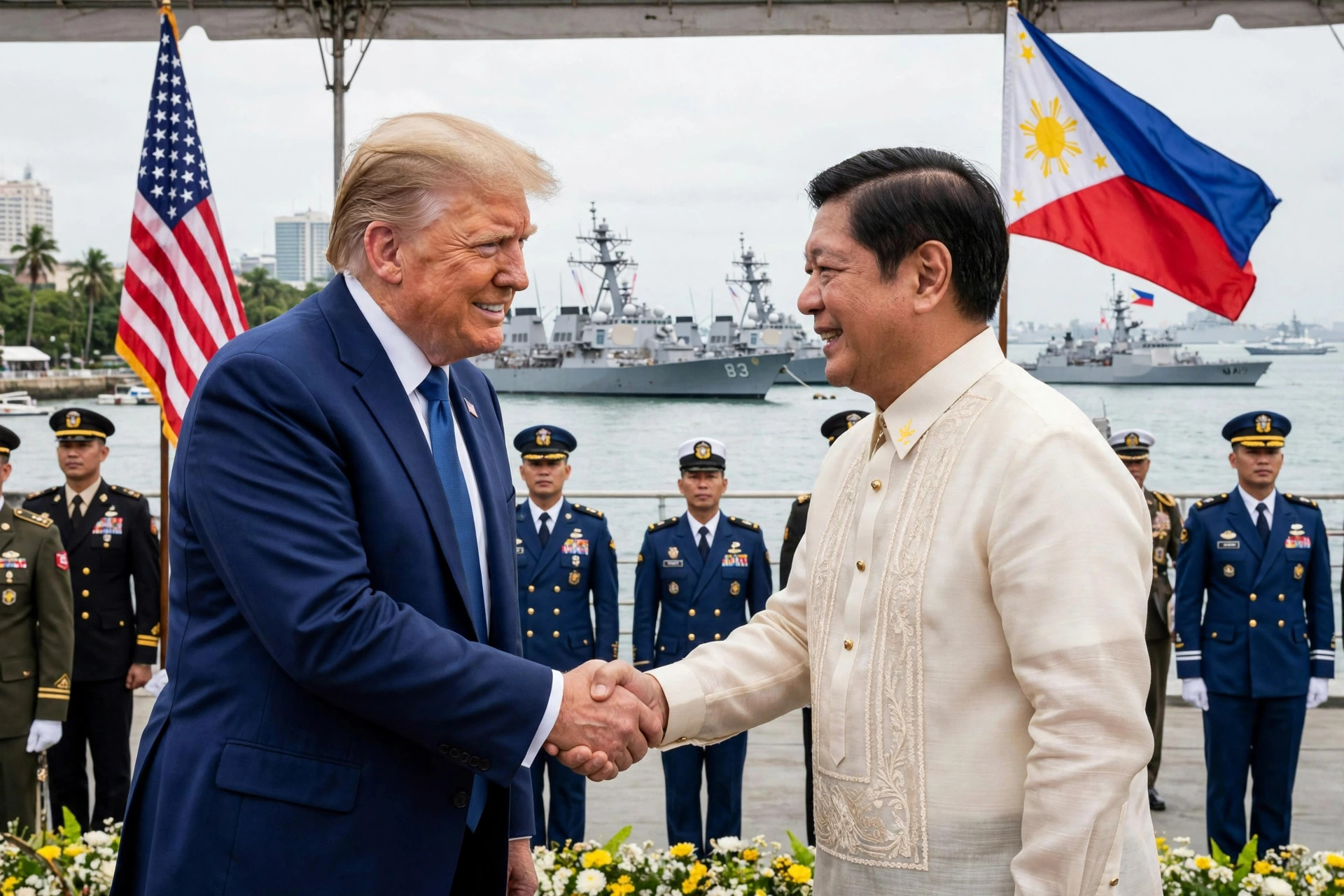
The United States has unveiled a defence package worth more than $2.4 billion for the Philippines, in the biggest American military financing offer to its oldest treaty ally in Asia in years. The announcement, made as President Donald Trump wrapped up a state visit to Manila last week, is designed to sharpen the Philippines’ deterrent in the South China Sea — but, as analysts have been quick to point out, most of the money is a loan, and it comes with strings attached.
What the Philippines defence package contains
According to a White House fact sheet released on 18 November, the package has two parts: a proposed Foreign Military Financing loan package of more than $2 billion, and $400 million in direct military financing. The loan would let Manila buy critical defence and security equipment from American suppliers, while the $400 million is earmarked for long-range fires, command and control systems, critical infrastructure and multi-domain drones.
Jobs and industry on the American side
The White House said the proposed loan would support more than 7,000 American jobs. Speaking after his return from Asia, Mr Trump said the agreement involved “more than $2 billion in American-made equipment, which will increase significantly”, and added: “We affirmed the historic bonds between our countries.”
The catch: a loan tied to American weapons
The headline figure conceals an important caveat. Because most of the package is a loan rather than a grant, the Philippines would be bound to spend it with American defence contractors. Chester Cabalza, founder and president of the Manila-based think tank International Development and Security Cooperation, told the South China Morning Post that the loan “contains a contract that we exclusively buy their defence materiel”.
Analysts also note that much of the funding had already been approved under previous commitments: the loan was revived from the US National Defence Authorisation Act, and multi-year foreign military financing is already set to begin this year.
The package is also subject to US congressional funding and oversight, and Washington has not clarified whether it is separate from the previously authorised $2.5 billion in military grants under the Philippines Enhanced Resilience Act, which provides for up to $500 million a year from fiscal years 2026 to 2030.
Why Washington is backing Manila now
The deal was struck during Mr Trump’s two-day state visit to Manila, where he met President Ferdinand Marcos Jr at Malacañang and attended the 49th Association of Southeast Asian Nations Summit. The two countries’ alliance rests on the 1951 Mutual Defense Treaty, and Washington has been pressing allies across the region to shoulder more of their own defence while buying American.
Mr Cabalza said Washington wanted “to strengthen Manila to build a network of allies that are capable of defending their own sovereignty and willing to contribute to regional security”. The White House, for its part, said its “America First Arms Transfer Strategy ensures that the surge in allies’ spending benefits the US defense industry”.
What happens next
The defence package sits alongside more than $17 billion in commercial deals announced during the visit, including a $12 billion agreement for Philippine Airlines to buy up to 20 Boeing 787 aircraft. The two governments also agreed to explore an intergovernmental deal on civilian nuclear energy — the first such US agreement with an Indo-Pacific partner — and announced a $40 million fuel depot at Subic Bay.
For Manila, the test now is whether the financing turns into hardware on the ground. Until Congress approves the funding and contracts are signed, the $2.4 billion remains a promise — one that could either transform the Philippines’ military or deepen its dependence on Washington’s defence industry.
Related coverage on TrendWire
- ASEAN Summit Opens in Manila as World Leaders Gather
- UK Gives Ukraine 1,000 Long-Range Drones in £260m Package
- Trump Delays Iran Strike Decision Until New Year
Tags: #Trump #Philippines #SouthChinaSea #USDefence #MilitaryFinancing #ASEAN #Marcos #DefenceNews
Comments (0)